
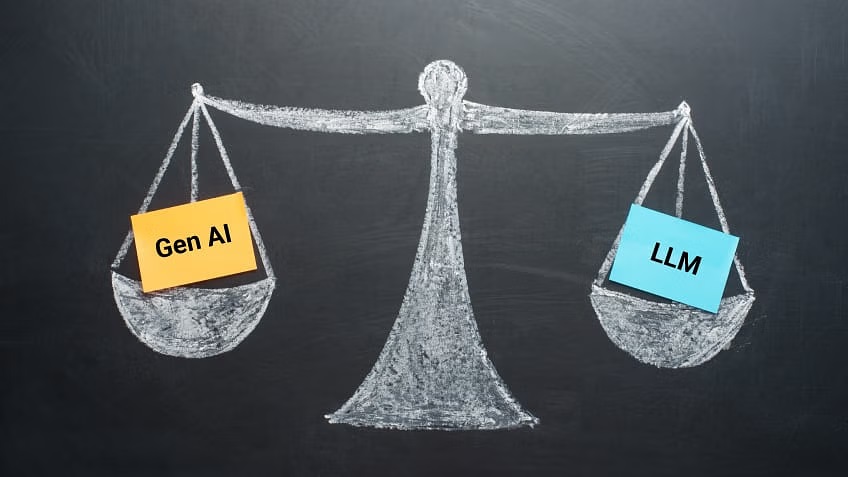
In the field of artificial intelligence, the phrases “Generative AI” and “Large Language Models” (LLMs) are sometimes used synonymously, however they refer to different ideas. Investigating the definitions, features, and areas of overlap between different technologies is crucial to gaining a deeper understanding of them. The main distinctions and points of convergence between generative AI and LLMs are intended to be made clear in this essay.
What is Generative AI?
Systems that can create original, new content after training are referred to as generative AI, a large subset of artificial intelligence. These models, which may generate new data like writing, music, or graphics, are trained on enormous datasets. Its capacity to produce intricate and imaginative outputs like music, art, or code from simple input prompts is what sets generative AI apart. For instance, whereas MusicLM is capable of producing original music tracks, DALL-E and Midjourney are programs that make pictures. Its central thesis is that these models generate new content rather than just predictions or classifications. When we talk about LLM vs Generative AI, it’s important to understand that LLMs (Large Language Models) are one category within the broader generative AI umbrella, primarily focused on generating text-based outputs.
What Are Large Language Models?
One particular branch of generative AI is called large language models, or LLMs. As the name implies, LLMs are AI models that have been extensively trained on textual data, and their primary focus is producing language that appears human. Patterns learned from training data are used by LLMs such as GPT (Generative Pretrained Transformer) to produce and predict text. These models are able to do a variety of natural language activities, such as responding to inquiries, writing emails, and having intricate discussions. For example, GPT-4 is a great illustration of an LLM that has been optimized for conversational applications like as ChatGPT.
Key Differences between Generative AI and LLMs
Though not all generative AI models are LLMs, all LLMs are a type of generative AI. The data they are trained on and the output they produce are where the main differences can be found. Content in formats other than text can be produced using generative AI, which spans a wide range of fields like music and image creation. Conversely, LLMs are solely concerned with text production. Furthermore, LLMs, like GPT, are trained on vast textual datasets expressly to predict and produce language that is similar to that of humans.
Conclusion
Finally, LLMs are a specific type of Generative AI that focuses on text, whereas Generative AI is any AI model that can produce new content. Whether traversing the AI landscape for technical, creative, or business purposes, it is essential to comprehend their differences and overlaps. These technologies may become even more entwined as AI develops, creating new opportunities for innovation in a variety of industries.
 Evaluation Tech