
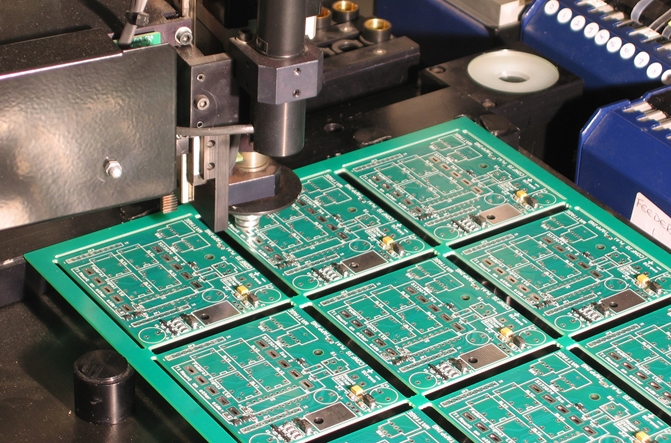
PCB fabrication is the act of combining the different materials of a board into functional layers in order to create a bare printed circuit board. These materials are referred to as “board materials.” The following steps are involved in the production of bare printed circuit boards:
- Review of the design: Before the PCB fabrication process can begin, the engineering team must first conduct a review of the design. This type of check is known as a “design for manufacturability” check, and its purpose is to confirm that the design in question is sound and that it satisfies the tolerances and criteria that must be met throughout production.
- Application of Film: The China PCB design is printed onto films by means of laser direct imaging, which results in the production of photo negatives of the board layout. Before these films can be used as guides for the different production steps, they must be put on the layers of material.
- Copper etching: In this process, undesirable or surplus copper is etched away or removed using a variety of techniques in order to form traces and pads. In most cases, this procedure requires a number of passes through the cleaning process in order to get rid of unused materials and chemicals.
- After copper etching, multi-layer boards’ inner and outer layers are aligned. The layers of a single-layer board are laminated. This is usually done via board-drilled alignment holes. After inspection, an epoxy-based prepreg is injected between layers, and the board is laminated using heat. The epoxy melts, adhering the layers.
- Drilling: Once the layers of the board have been bonded together, the next step is to create holes through the board by using a drill. Mounting holes, through-holes, and vias all make use of these holes in various configurations.
- Plating: Following the completion of the drilling process, the circuit board is then plated with a coating of copper that is one micron thick. This layer coats the interior of the drilled holes, producing plated through-holes. After this step, the outer layer of the board will often undergo additional etching, after which the copper will be removed.
- Solder masking: The panels are cleaned and solder-masked when the copper layers are finished. The solder mask makes the PCB green. During the installation process, the solder mask prevents the copper wires from coming into contact with other conductive materials by accident. The printed circuit board is then heated in an oven to solidify the solder mask layer after it has been applied.
- Silkscreen: Whether or not this step is required, the next step is the application of the silkscreen, and then the board goes through the final curing cycle after that.
During electronic assembly, the silkscreen layer is typically applied on top of the solder mask layer. Silkscreening, the technique of adding letters, numbers, and symbols on a printed circuit board (PCB), is typically carried out in white. During the process of assembling the PCB, this silkscreen layer is used to help determine the type of component and its location.
- Surface finishing: Once the solder mask and silkscreen have dried, the surface of the China PCB can be plated with gold, silver, or another type of surface finish to assure its functionality and protection.
 Evaluation Tech